|
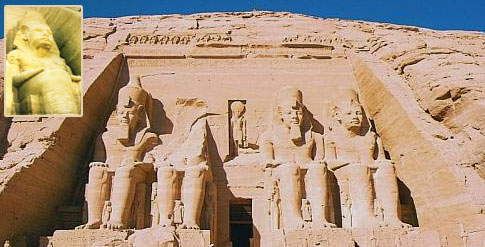
Each year, on the 22nd of February, the sun always tends to be perpendicular on for 20 minutes on Kuds Al-akdas it Ramses II’ temple in Abou Simble ,south Aswan. Namely, the sun rises on just the face of Ramses statue but it (the sun) tends to be perpendicular for two times on the whole statue every year. The first time on the 22nd of February- the birthday of the king Ramses II, announcing thus the start of "Shmo" season that means" Harvest season" in ancient Egyptian language and reflects the beginning of summer according to the astrological calendar by the ancient Egyptians as a unit for measuring time, the second time, on 22nd of October the day on which the king ascended the throne- announcing the onset of winter.
"Emilia Edward" was the first person to monitor that controversial phenomenon inside Kuds Al-akdas and recorded it in her famous book thousand miles on the Nile in 1899. This event assured the fact that pharaohs progressed in astrology, Geography, engineering, architecture. It is worth mentioning that sunrays penetrate for a distance of 60 meters inside the temple of Ramses II until they reach Kuds Al –akdas to light three of the four statues available there, Raa Hour statue, the sister of sun god, Ramses II statue, and thebes god statue, Amoun. The fourth statue, on the other hand, has no access to sun rays and it belongs to ptah must remain in the dark as it actually be in the lower world.
The great Abou simble’s temple, devoted to Ramses II and the small one devoted to Ramses wife, queen Nevertary, were both sculptured inside the mountain on the west of beach of the Nile but when the high Dam was built, in the 1960s, Egypt was forced in cooperation with UNESCO, to cut that mountain and transfer the two temples to be place few hundred meters away from their original position with the same angle and direction.
Ramses II is the third pharaoh of the 19th dynasty and ruled Egypt for 66 years from (1279-1212 B.C). Queen Nevertary was one of his famous wives and he had about 90 sons and daughters.
The kind led several campaigns north to the Levant and the "second Kadesh" battle, the Egyptian forces led by Ramses engaged with "Al-haitheyyen" forces led by their king mutates but hither side defecated the other over years. So, in 1258 B.C a peace treaty was signed between Egyptians and Al-haitheyyen and considered the oldest peace treaty in history. A lot of temples, statues including Abou simble compound were constructed by Ramses II who left statues more than any other pharaoh.
Ramses was buried in the Valley of the Kings in the tomb Kv7 but his mummy was transferred to the sea monastery as it was discovered in 1881 to be transferred to the Egyptian museum in Cairo after five years since then.
The king was about 170 cms high, the matter that made him tall according to his time. Medical examinations show that the king's mummy has red hair and he was believed to suffer from sharp rheumatoid in arthritis within his last years as well as diseases s in the gums.
|